By: Rabbi Arthur Waskow
SELECTED BIBLIOGRAPHY OF RABBI ARTHUR WASKOW
Rabbi Arthur Waskow, Ph. D., founded (in 1983) and directs The Shalom Center, a prophetic voice in jewish, multireligious, and American life, which brings Jewish and other spiritual thought and practice to bear on seeking peace, pursuing justice, healing the earth, and celebrating community. He edits and writes for its weekly on-line Shalom Report.
In 1996, Waskow was named by the United Nations a Wisdom Keeper among forty religious and intellectual leaders who met in connection with the Habitat II conference in Istanbul. In 2001, he was presented with the Abraham Joshua Heschel Award by the Jewish Peace Fellowship. In 2005, The Forward national Jewish newspaper named him one of the Forward Fifty -- fifty Jews who were contributing most to the community -- and in 2007, Newsweek magaziune named him as one of the fifty most inFluential American rabbis.
http://www.shalomctr.org/node/1008
---
DANCING OR DENOUNCING IN THE WORLD-WIDE EARTHQUAKE - MUSLIMS, CHRISTIANS, JEWS
Dear friends,
Sometimes the earth on which we stand begins to shake, uncontrollably. We can respond with measured concern, even fear, and reach out for help to each other; or we can respond with panic and rage against anyone we think might be responsible for the earthquake. We can try to grab on to some "immovable" strong point - or we can learn to dance, with each other, in the earthquake.
Recently there have been several important moments when various parts of the "official" established American Jewish organizational structure have been feeling they are living in a totally unexpected earthquake (see below for its description), and some have responded with panic, lashing out at some imagined "cause."
One form that took was attacking some progressive Jews as "enablers" of anti-Semitism. Another it has taken - one I found myself dealing with in my own life this past week, not just on paper -- is attacking some Muslim organizations and trying to keep mainstream American politicians from treating them as parts of our democratic fabric.
So I will tell the story, which is both important in itself and a micro-version of the bigger problem.
About a month ago, I was invited to speak at the first annual dinner of the Pennsylvania chapter of the Council on American-Islamic Relations (CAIR), evidently because I had taken part in a pray-in to protest against the exclusion of a group of imams from flying - and maybe because I also knew and was known by Iftekhar Hussain, head of the Pennsylvania chapter.
At that point the only CAIR folks I knew were Iftekhar and Ahmed Bedir, who leads a Florida chapter of CAIR. Him I knew through the Tent of Abraham, Hagar, and Sarah, the group of Jews, Christians and Muslims, that has been meeting for almost four years and has initiated a series of multireligious projects.
They include the "Sacred Season of Shared Sacred Seasons," which this fall continues when Ramadan, the High Holy Days, Worldwide Communion Sunday, and the Feast of St. Frances are intertwined) and a book of which I'm co-author with Sister Joan Chittister and Murshid Saadi Shakur Chisti, The Tent of Abraham: Stories of Hope and Peace for Jews, Christians and Muslims (Beacon, 2006).
I respect both Iftekhar and Ahmed deeply, and know them for compassionate, intelligent, and peaceful people, bringing a wise and compassionate understanding of Islam to work for justice and peace in America. So I readily said Yes.
Since I knew little about National CAIR, I did some reading - especially of a major article in the NY Times on ways they were being harassed, often by right-wing organizations in the Jewish community who claimed they were associated with terrorists. But the article made clear that CAIR works with the Federal government, is respected by Federal law-enforcement agencies, and speaks out strongly for civil liberties and human rights. Not a terrorist profile. For the whole article, see ---
http://www.shalomctr.org/node/1252
My careful reading of the Times article and my browsing on the CAIR Website strongly indicated that attacks on CAIR have little or no substance and are based on the kind of innuendo and strings of X to Y to Z to A that made infamous the names of Joe McCarthy and Roy Cohn.
Just as I was being invited to speak, so was Congressman (and former Admiral) Joe Sestak, newly elected to Congress from a suburban Philadelphia district on a strong antiwar platform. He accepted.
And then some Jews in his congressional district complained. They urged him to renege.
So I not only said yes to my own speaking, I wrote encouraging Congressman Sestak to continue with the courage and good sense he had already shown in treating Philadelphia CAIR and its members as full members and participants in the democratic process, to be honored by him as well as to honor him.
So now let me report on the dinner itself, this past Saturday evening -- and on its aftermath - especially a half-bottomed story in the Philadelphia Inquirer and my letter to the editor about it.
Sestak did speak, both affirming the Muslim presence and activism in America and urging some changes in CAIR's positions. He received a standing ovation.
AND there was a protest band of three or four picketers, all Jewish, outside the hall, angry that Sestak was speaking. A larger number of Jews attended as supporters, including another rabbi besides me; and there was a supportive letter from one additional rabbi in the printed program, and a supportive ad from a smallish activist Jewish organization, Jewish Voice for Peace.
I spoke as a religious Jew committed to peace between Israel and Palestine and to peace between the United States and the Muslim world -- speaking to religious Muslims who strongly applauded my call for renewed dedication to a peaceful two-state Israel-Palestinian peace settlement. They strongly applauded my remarks about the need for each single one of us members of the family of Abraham to feel personally wounded when any member of the family kills another.
Former Ambassador Ed Peck gave the keynote address. Some of his family were Jewish, and were murdered in the Holocaust. Governor Ed Rendell of Pennsylvania gave a warm and warmly received speech. He is himself Jewish and has excellent relations with both the Jewish and Muslim communities in Philadelphia.
Yet the article that appeared next day in the Philadelphia Inquirer, on the lead space in the Metropolitan section, spun the event into a seeming collision between the Jewish community and CAIR. None of the supportive Jewish presences -- people, speeches, program book -- were reported in the article. Rendell's presence was barely mentioned. Peck was not mentioned at all.
And while the article reported the utterly uncorroborated assertions by two local Jews that CAIR "has connections to terrorists," it did not report that in fact CAIR speaks out strongly against terrorist attacks by Muslims.
Feeling that this kind of reporting gives credence to McCarthyesqe lies, I wrote both the reporter who wrote the story and a Letter to the Editor. The latter (nibbled a good bit around the edges by the Inquirer's editors, and with one very important missing piece) was published this morning, along with a parallel letter from a Muslim who had attended the dinner and who praised Jewish "moderates [who] represent the true voice of the Jewish community."
The piece missing from my letter had pointed out how reporting a slander without the facts refuting it is a way of giving credence to the kind of falsehood that besmirched the names of McCarthy and Cohn.
And this is perhaps the most important fact about the whole affair. For this event does not, unfortunately, stand alone. Recently, in California, Senator Barbara Boxer "rescinded" an award for active democratic citizenship she had given to a CAIR worker, after pressure from some limited parts pf the Jewish community. When there was a rousing protest against her rescinding the award, she retreated into silence.
Why is this sort of thing happening?
One response to finding one's self shaken by an earthquake of change is - panic. Not reasoned and measured concern or even fear integrated into an effective response, but unreasoning and often self-destructive panic. And one form THAT takes is lashing out against anyone perceived to be connected with the earthquake. Lashing out through slander intended to delegitimate anyone who suggests another way of dealing with the earthquake.
Many Americans responded in this way after 9/11. The Iraq War and the suspension of many age-old civil liberties and human rights - habeas corpus, the right to an attorney, the right to know what charges are being made, the right not to be tortured - were "justified" and enabled by that panic.
And - especially since the Israeli government's 2006 invasion of Lebanon and its abject failure, especially since the discovery that if military force is the only choice the Israeli government makes as a way to protect Israel, then Israel's heartland cities like Haifa can come under attack - there is a similar kind of spreading sense of dislocation, earthquake, panic among the officials of some American Jewish institutions. Their assumptions of invulnerability begin to unravel.
One response might be to rethink the assumption that military domination is the wisest path to security. But most of them have found it easier, at least in the short run, to circle the military wagons and press on with more of the same.
Slander is a quasi-military response if in fact you cannot use outright violence (and American Jewish institutions, short perhaps of the Jewish Defense League and its heirs, cannot). Slander is intended to terrorize at the political and psychological level, to make people shut up. (In the old Jewish phrase, "l'havdil" - let's be clear this is not the same thing as the terrorism of blowing up a pizzeria.)
If the troubling folks shut up, maybe the earthquake will go away.
For the American Jewish Committee, this took the form of attacking a slew of Jewish progressives, many of them creators of life-filled and rejuvenating forms of Jewish cultural and spiritual renewal, as "enablers" of anti-Semitism because they do not share the notion that the State of Israel is the be-all and end-all of Jewish life and future.
For others in the official Jewish institutional structure, it means attacking not only CAIR -a Muslim group that condemns the use of terrorism by Muslims - but also any American politician who treats CAIR or other Muslim groups or for that matter the newly bubbling Jewish peace groups as legitimate parts of the democratic process.
For Jewish Republicans, that attempt at shutting people up has the added benefit of trying to frighten and defeat some politicians who (like Congressman Sestak) oppose the Iraq war in part because they have a broader view of how to deal with the Middle East.
Of course I am not saying that CAIR is perfect, that I always agree with it, or that there is no point in Muslims and Jews not only listening to each other and encouraging each other but also arguing, debating, dialoguing, wrestling with each other - in both directions, neither just Jews nor just Muslims insisting on their own perceptions as the only reasonable ones.
At the dinner itself, there were certain phrases used by one of the CAIR speakers that troubled me. I began a conversation about them, and will continue.
Aside from phrases, there is one outlook of CAIR's that has led to criticism. CAIR strongly condemns terrorist actions, but not whole organizations.
To many American Jews, its unwillingness to make a blanket condemnation of Hamas or Hezbollah seems contradictory, if it really opposes terrorism - because most US Jews, and the US Government, define Hezbollah and Hamas as simply terrorist groups.
But CAIR points to the complex reality in which both groups are simultaneously woven of strands that include social-service organizations with schools and medical clinics, etc.; political parties; friendship groups and ethno-religious communities; police forces; and military / terrorist agents. Much of the non-military parts of this complex, in both organizations, meets real needs on the ground, and much of it is woven into Palestinian or Lebanese society.
Indeed, there is considerable evidence that inside Hamas, at least, there are different sub-groups with competing views and policies about terror and violence. Careful ethical challenges to the use of terror could actually help strengthen the peaceful forces. So CAIR's view is that to condemn the whole organization outright, as distinct from specific terrorist actions, is to demonize all its parts instead of trying to peel away the disgusting actions that CAIR does oppose.
To me this view roused some interesting echoes of my own criticisms of parts of the so-called Left that attack Israel - the whole society or its whole government - instead of condemning specific aggressive and oppressive policies and actions of the Israeli government.
Perhaps there is some way to condemn specific actions while naming, but not condemning, the organizations that are partly involved - as I do when I condemn particular actions of the Israeli government, naming it while not attacking the government as a whole.
There will be enormous value in pursuing such discussions with each other, once more learning deeply what it means to stand in the shoes of "the Other," dancing in the quaking circle of reality.
What does NOT help is slander and intimidation. The earthquake in which we all live is frightening, and we are more likely to survive and grow by dancing in it together rather than trying to scare others into leaving the dance floor.
So I am hopeful that the dinner last week is a spark of light. Far from showing irreparable conflict between the Jewish community and CAIR, in fact the dinner showed that a seriously peace-committed part of the Jewish community can work with a seriously peace-committed part of the Muslim community, despite the existence of some violence-supportive people in both communities.
That is the truthful and the important story.
And that is the future we need to create. Dancing -- with each other -- in the earthquake.
Shalom, salaam -- -
Rabbi Arthur Waskow
Co-author, The Tent of Abraham;
Director, The Shalom Center
About Me

- Hussam Ayloush
- Hussam has been a lifelong human rights activist who is passionate about promoting democratic societies, in the US and worldwide, in which all people, including immigrants, workers, minorities, and the poor enjoy freedom, justice, economic justice, respect, and equality. Mr. Ayloush frequently lectures on Islam, media relations, civil rights, hate crimes and international affairs. He has consistently appeared in local, national, and international media. Full biography at: http://hussamayloush.blogspot.com/2006/08/biography-of-hussam-ayloush.html
Friday, April 13, 2007


Monday, April 09, 2007
Mend growing West-Islam rift by reading, taking trips abroad
Commentary by Hussam Ayloush
Published in the Press-Enterprise, 4/8/07
With the rapid spread of misinformation on the Internet and TV, and the destructive conflict in the Middle East, no one can afford to ignore a widening cultural, religious and political divide between the West and Islam.
Zogby International and the Gallup Center for Muslim Studies conducted polls in six "friendly" Muslim countries and reported that only 12 percent of respondents had a positive attitude toward the United States. Similarly, a Gallup survey reported that nearly 40 percent of Americans admitted to having some prejudice toward Muslims.
However, according to a BBC World Service poll across 27 countries, a majority of Muslims and Christians believe that the problem mostly derives from political conflict rather than a conflict in values or culture. They also believe that Muslims, non-Muslims and Westerners reject the idea that violent division is inevitable between Islam and the West.
Many people in the world, including Americans, strongly disagree with our government's foreign policies -- such as the Iraq war, and unconditional support for Israel and dictatorships in the Middle East. Those policies cause some in the Muslim world to falsely blame all Americans for the administration's policies.
Unfortunately, people fear what they don't know. So, the key to bridging the cultural and religious gap between Muslim countries and the West is to facilitate discourse, support interaction and reject stereotyping. This will foster the right atmosphere to resolve the political grievances.
For starters, we should encourage tourism and student exchanges. Americans should break bread and sip tea with Muslims, and visit countries such as Turkey, Egypt and Morocco that are rich in cultural history. Muslims in Senegal, Indonesia, Lebanon and China should visit Western countries. Such exchanges bring about learning and appreciation of other cultures.
Another effective tool in bridging the divide is good, old-fashioned reading. Read books by Rumi, Ibn Khaldun, Mark Twain and Maya Angelou. Read the Quran. Read the Bible. We should step out of our comfort zones and explore the world beyond our street corners.
Americans have an advantage, in that corporations have successfully exported our culture to the rest of the world. People all over the world are familiar with American products and culture. Sadly, this hasn't encouraged us to learn about other cultures.
Such lack of education becomes critical when dealing with the Muslim world, especially as extremists from all sides seek to widen the divide with the West.
In the Quran, God tells people, "O mankind! Lo! We have created you from a male and a female, and have made you nations and tribes that you may know one another. Lo! The noblest of you, in the sight of God, is the best in conduct." (49:13)
Hussam Ayloush is executive director of the Council on American-Islamic Relations in Southern California.
Published in the Press-Enterprise, 4/8/07
With the rapid spread of misinformation on the Internet and TV, and the destructive conflict in the Middle East, no one can afford to ignore a widening cultural, religious and political divide between the West and Islam.
Zogby International and the Gallup Center for Muslim Studies conducted polls in six "friendly" Muslim countries and reported that only 12 percent of respondents had a positive attitude toward the United States. Similarly, a Gallup survey reported that nearly 40 percent of Americans admitted to having some prejudice toward Muslims.
However, according to a BBC World Service poll across 27 countries, a majority of Muslims and Christians believe that the problem mostly derives from political conflict rather than a conflict in values or culture. They also believe that Muslims, non-Muslims and Westerners reject the idea that violent division is inevitable between Islam and the West.
Many people in the world, including Americans, strongly disagree with our government's foreign policies -- such as the Iraq war, and unconditional support for Israel and dictatorships in the Middle East. Those policies cause some in the Muslim world to falsely blame all Americans for the administration's policies.
Unfortunately, people fear what they don't know. So, the key to bridging the cultural and religious gap between Muslim countries and the West is to facilitate discourse, support interaction and reject stereotyping. This will foster the right atmosphere to resolve the political grievances.
For starters, we should encourage tourism and student exchanges. Americans should break bread and sip tea with Muslims, and visit countries such as Turkey, Egypt and Morocco that are rich in cultural history. Muslims in Senegal, Indonesia, Lebanon and China should visit Western countries. Such exchanges bring about learning and appreciation of other cultures.
Another effective tool in bridging the divide is good, old-fashioned reading. Read books by Rumi, Ibn Khaldun, Mark Twain and Maya Angelou. Read the Quran. Read the Bible. We should step out of our comfort zones and explore the world beyond our street corners.
Americans have an advantage, in that corporations have successfully exported our culture to the rest of the world. People all over the world are familiar with American products and culture. Sadly, this hasn't encouraged us to learn about other cultures.
Such lack of education becomes critical when dealing with the Muslim world, especially as extremists from all sides seek to widen the divide with the West.
In the Quran, God tells people, "O mankind! Lo! We have created you from a male and a female, and have made you nations and tribes that you may know one another. Lo! The noblest of you, in the sight of God, is the best in conduct." (49:13)
Hussam Ayloush is executive director of the Council on American-Islamic Relations in Southern California.
Thursday, April 05, 2007
Muslims React to Pelosi's Visit to Mideast

For a week now, House Speaker Nancy Pelosi, accompanied by a small bipartisan group of members of Congress, has been visiting several countries in the Middle East. Unlike typical visits by Bush administration officials which are usually characterized as meetings to deliver an ultimatum, a warning, a patronizing lecture, or a war threat, this visit was described as a visit for dialogue and peace.
Indeed, the visit not only included the usual meetings with public officials, but also scheduled visits to Muslim, Christian, and Jewsih religious sites, touring popular markets, and face-to-face interaction with common people on the street.
The visit projected a true image of our country that has long been overshadowed by the arrogant and war-mongering rhetoric of the neo-cons and their representatives in this Administration.
 People of the Middle East were touched and amazed to hear and meet an American leader who spoke about mutual respect, dialogue, peace, and friendship. For a while, they had gotten the impression that we Americans were only interested in wars, invasions, occupation, oil, insulting Islam, and selfishly looking after our own (corporations') interests, no matter what the human, moral and economic costs might be.
Pelosi and her team reminded the world that we in America still stand for all the good things people hope for. We stand for everyone's true freedom, not only ours. We stand for peace, not war. We stand for tolerance and cooperation, not polarization and division. We stand for democracy and human rights, not Guantanamo and torture.
 Pelosi's visit has dusted off from an old but effective U.S. foreign policy tool called diplomacy.
Lately, the only foreign policy tool used by this administration has been war or the threat of war. Dialogue and diplomacy undermine the radicals on all sides and help resolve conflicts. Wars, on the other hand, fuel extremism and anger.
I just pray that the Speaker of the House can hold her ground against pressure from the war mongers in our country. The present conflict is not between the West and Islam. Rather, it is rather between those who believe in peace and justice and those extremists who believe in hatred and war. The fact is that both camps include people from all faith backgrounds.
Photo captions. 1) AP - Pelosi accepting dried figs at the Souk (market) in Damascus; 2) Reuters - Pelosi praying at the grave of John the Baptist in the Umayyad Mosque in Damascus; 3) Reuters - Pelosi with Syrian Muslims at the Umayyad Mosque in Damascus.
Below are sample comments from the Arab world. The comments were posted in Arabic on the Al-Jazeera and Al-Arabiya websites – the two most popular Arab news websites. I did a rough translation.
"This lady (Nancy Pelosi) has all the political experience, humanity, wisdom, and leadership skills to be the next president of the United States of America." -Abu Ahmad
"I firmly believe that Ms. Pelosi has done a great and correct act. Dialogue with Syria is crucial in order to achieve solutions that benefit both American and Syrian peoples. (President) Bush will see in the future that he was wrong in criticizing that trip." - Adnan
"Both sides (Pelosi and Assad) have to close their ears to the calls from the war mongers and they should quickly take initiatives that will stop this festering historical enmity. If there is a war then everyone will lose. If there is peace then everyone will win. Courageous decisions have to be made, even if they seem painful because the majorities among both peoples realize that peace is the solution to all their problems." - Abdul Rahman Al-Alwani
"I stand in respect for Ms. Pelosi for she is a brave person who has a great insight. We know that (to Pelosi) American interests are above any other consideration. What is important is that she came to the Middle East to learn and listen to all parties. (President) Bush resorted to war and this measure was useless. War is destruction. America should work to promote peace in the world so it can lead the world." - Anonymous
"I believe that this is a positive step on the right path towards achieving calm to the volatile Middle East. It is sufficient that this visit shows that there are wise (leaders) in America, and that the bias is not completely towards Israel, but that there are some who try to push things forward." - from Al-Mansoura/Egypt
Here is what American Muslims had to say:
CA MUSLIMS WELCOME SPEAKER PELOSI'S VISIT TO MIDEAST
(SANTA CLARA, CA, 4/5/07) - The San Francisco Bay Area chapter of the Council on American-Islamic Relations (CAIR-SFBA) today commended House Speaker Nancy Pelosi for the spirit of dialogue and mutual respect she exhibited during her visit to the Middle East.
In a statement, CAIR-SFBA said:
"We applaud Speaker Pelosi's initiative to use constructive dialogue as a tool for resolving conflicts. America's stature in the Islamic world has been harmed by the Bush administration's emphasis on the use of military force, or the threat of force, rather than dialogue and diplomacy. Speaker Pelosi's visit to the Middle East is a vital step forward in both improving our nation's international image and building better relations with important nations in that volatile region.
"In particular, Speaker Pelosi's visit to the Umayyad mosque in Damascus will contribute greatly to promoting mutual understanding between the West and the Muslim world. It is through mutual understanding that religious divisions and extremism can be challenged and reduced.
"We urge President Bush to implement the recommendations of the Iraq Study Group by working with Congress and Speaker Pelosi to formulate a new strategy that focuses on diplomacy and dialogue, not military force and belligerent rhetoric."
CAIR-SFBA also commended other Democratic and Republican members of Congress who are making similar visits to the region.
Thursday, March 22, 2007
Eventually, the truth prevails
An update on my car adventure.
I got a call from the shop to inform me that my car was found a few blocks away from their shop. It seems that the thieves realized that the car is not as good as it appears and decided to leave it.
The body was intact, but the inside of the car was completely damaged. The car is now being repaired, again. Hey, I am getting a new radio and CD player as well as speakers in lieu of the stolen ones (The stolen ones were lousy). May be now I can listen to the new Quran CDs that I received last year.
Anyway, the lesson is that new paint might have fooled someone into believing that the car is some fancy car, but a quick driving test exposed the truth about the car's condition.
The bigger lesson, which I hope you got by now, is that we often judge others based on what we see on the outside, their looks, their social status, their race, their claimed religion, etc.; however, it is only after we get to know them and interact with them at close that we can discover their true character.
If people try hard to look deeper than the surface, they will see the truth. Eventually, the tuth prevails, but it often needs our help to break out.
As Prophet Muhammad (peace be upon him) prayed, I pray that God/Allah show us the truth as clear truth and give us the strength and courage to follow it. And to show us falsehood as clear falsehood and give us the strength and courage to avoid it.
I got a call from the shop to inform me that my car was found a few blocks away from their shop. It seems that the thieves realized that the car is not as good as it appears and decided to leave it.
The body was intact, but the inside of the car was completely damaged. The car is now being repaired, again. Hey, I am getting a new radio and CD player as well as speakers in lieu of the stolen ones (The stolen ones were lousy). May be now I can listen to the new Quran CDs that I received last year.
Anyway, the lesson is that new paint might have fooled someone into believing that the car is some fancy car, but a quick driving test exposed the truth about the car's condition.
The bigger lesson, which I hope you got by now, is that we often judge others based on what we see on the outside, their looks, their social status, their race, their claimed religion, etc.; however, it is only after we get to know them and interact with them at close that we can discover their true character.
If people try hard to look deeper than the surface, they will see the truth. Eventually, the tuth prevails, but it often needs our help to break out.
As Prophet Muhammad (peace be upon him) prayed, I pray that God/Allah show us the truth as clear truth and give us the strength and courage to follow it. And to show us falsehood as clear falsehood and give us the strength and courage to avoid it.
Tuesday, March 20, 2007
Judging a car by its paint
I am not big on cars. I am simple. I just need a vehicle that can fit me (I am tall), my 4 kids, and my many boxes filled with work related material (I am not even sure I ever use most of that junk, at least that’s what my wife claims).
My black Isuzu is a loyal transportation tool. It tolerated my abuse and negligence. At least that’s what I think since it rarely complained. It takes me places, many far away places, as my CAIR work duties will send me. This Isuzu has visited more mosques, churches, schools, colleges, television stations, and meeting places than most people have. As long as it has gas (and some oil too) it is ready to move (I actually confirmed, the hard way, that without gas, a car eventually stops running!)
The car is a 1995 (or 1996) model. I bought it 3 or 4 years ago. It has its old-age problems. One of the windows does not shut completely which causes a loud wind noise when cruising on the freeway (something we rarely do on CA freeways). I personally got so used to it that I don’t notice it anymore. It is only when new passengers ride with me that they notice it and remind me of it. The body paint has faded so much that other drivers avoid parking next to it for fear that the terrible paint disease that afflicted my car might be contagious. All of this has worked well for me. I never had to worry about locking the car. No one would steal it.
But things changed. Last month, while attending an interfaith event in Long Beach, I came out to find that someone slammed into my car's front. Luckily, my insurance covered for the damage (minus my deductible, grrr...). I sent my Isuzu (which I now learned is also a Rodeo model) to the shop and it came back like a brand new car, at least from the outside. I never realized how much of a difference paint can make. As I drove it again, I discovered additional mechanical problems in the transmission that did not exist prior to the incident. The insurance company advised me to send it back to the shop which in turn sent it to a transmission specialist to have it checked.
Today, I got a call from the shop telling me that they had some bad news for me. They informed me that car thieves managed to break into the transmission shop last night and moved three other cars in the front of the garage in order to get to my car and steal it. Although I was not happy to learn that my dear car was stolen, I can't hide that I was slightly proud that my car was wanted so bad. I was flattered that those thieves would risk going to jail to take my car. I swear I could have given them a good deal on it. I guess the new paint tricked the thieves into believing that this is a somehow a new car. Little did they know about the transmission problem (suckers!). I just hope they don't sue me for false advertisement.
For now, I was told to wait until we see if the police can locate my car.
Today, I was reminded that most people rush to judge matters by their appearance, a book by its title, and a car by its paint.
My black Isuzu is a loyal transportation tool. It tolerated my abuse and negligence. At least that’s what I think since it rarely complained. It takes me places, many far away places, as my CAIR work duties will send me. This Isuzu has visited more mosques, churches, schools, colleges, television stations, and meeting places than most people have. As long as it has gas (and some oil too) it is ready to move (I actually confirmed, the hard way, that without gas, a car eventually stops running!)
The car is a 1995 (or 1996) model. I bought it 3 or 4 years ago. It has its old-age problems. One of the windows does not shut completely which causes a loud wind noise when cruising on the freeway (something we rarely do on CA freeways). I personally got so used to it that I don’t notice it anymore. It is only when new passengers ride with me that they notice it and remind me of it. The body paint has faded so much that other drivers avoid parking next to it for fear that the terrible paint disease that afflicted my car might be contagious. All of this has worked well for me. I never had to worry about locking the car. No one would steal it.
But things changed. Last month, while attending an interfaith event in Long Beach, I came out to find that someone slammed into my car's front. Luckily, my insurance covered for the damage (minus my deductible, grrr...). I sent my Isuzu (which I now learned is also a Rodeo model) to the shop and it came back like a brand new car, at least from the outside. I never realized how much of a difference paint can make. As I drove it again, I discovered additional mechanical problems in the transmission that did not exist prior to the incident. The insurance company advised me to send it back to the shop which in turn sent it to a transmission specialist to have it checked.
Today, I got a call from the shop telling me that they had some bad news for me. They informed me that car thieves managed to break into the transmission shop last night and moved three other cars in the front of the garage in order to get to my car and steal it. Although I was not happy to learn that my dear car was stolen, I can't hide that I was slightly proud that my car was wanted so bad. I was flattered that those thieves would risk going to jail to take my car. I swear I could have given them a good deal on it. I guess the new paint tricked the thieves into believing that this is a somehow a new car. Little did they know about the transmission problem (suckers!). I just hope they don't sue me for false advertisement.
For now, I was told to wait until we see if the police can locate my car.
Today, I was reminded that most people rush to judge matters by their appearance, a book by its title, and a car by its paint.
Thursday, March 15, 2007
Muslims to join Annual Manzanar Pilgrimage
 38th Annual Manzanar Pilgrimage: A Visit to the largest Japanese American Internment Camp
WHAT: 38th Annual Manzanar Pilgrimage
WHEN: Saturday, April 28, 2007
The Manzanar Committee is dedicated to educating the public about the Japanese American internment camp experience by organizing the annual Manzanar Pilgrimage. This year, the Southern California office of the Council on American-Islamic Relations (CAIR-LA) is working with the L.A. Manzanar Committee and the Japanese American Citizens League (JACL) to bring members of the California Muslim community to join for a one-day visit of Manzanar. (See History of Manzanar below)


This is a great opportunity for community leaders as well as college students to participate and share their experience with their respective communities.
Citing the significance of the trip, Executive Director Hussam Ayloush said, "With the growing anti-Muslim sentiments and incidents across the country, it is important to relearn and remember part of our nation's history when we as a country committed great injustices against innocent Americans solely based on their heritage and background."

 For those interested in taking the bus from Los Angeles, two buses sponsored by The Manzanar Committee will be leaving Little Tokyo and Torrance by 7 am. Cost for the bus is $20 and must be prepaid. Overnight accommodations are the responsibility of each visitor and will need to be handled individually at the following sites. There is LIMITED space on the buses so please contact CAIR-LA to reserve a spot on the bus. If a large number of people express interest in participating, we can rent a separate bus. Call ASAP to let us know.
Each year, people enjoy the first class Manzanar Museum located in the renovated internment camp gymnasium, tour the camp site, and then attend an educational program at about 12 noon. The program is followed by an interfaith ceremony at the cemetery monument in the camp. The ceremony is followed by a Japanese folk dancing circle in which all participate, accompanied by taiko drumming. An estimated 300-500 people attend the day program.
 During the evening, the committee organizes a Manzanar After Dark program focusing on college students who come primarily from the San Francisco Bay Area and Southern California. Each year, there are cultural performances, small group discussions with former internees, and open mic session where students often do spoken work, stories, sing, and make brief statements.
---
Manzanar History
Prepared by the Manzanar Committee
 The camp, which consisted of 36 blocks of barracks within a confined area of one-square mile, was the scene of many hardships as men, women, and children sought to establish some semblance of normal life while attempting to overcome the trauma of forced evacuation and facing an uncertain future. It was the resourcefulness and labor of the camp population, which turned Manzanar into a habitable place for the remainder of their enforced stay.
 Manzanar had some unique features for a war-time city. It was the only relocation center with an orphanage, called "Children’s Village." It was also the only site in California which had an advanced sewage and water filtering system, dismantled when the camp closed. The surgical and nursing team developed at the Manzanar Hospital became the training center for nurses whose study was interrupted by the evacuation. It was there that they completed their training, graduating with a recognized degree to practice nursing on the "outside."
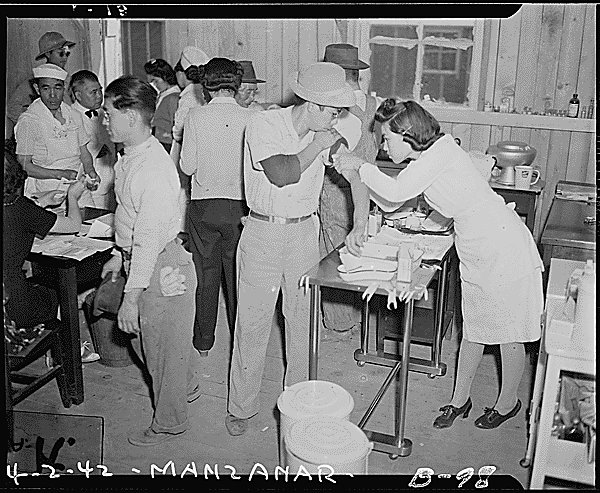 The apple trees for which Manzanar was named, had been abandoned prior to the war. They were pruned, fertilized and watered by Issei farmers during their internment, providing delicious apples for the internees. Many varieties that grew there are no longer available on the market.
Under the terms of the lease with the City of Los Angeles, which owned the land at Manzanar, the campsite was returned to its original condition. Barracks were auctioned off to returning veterans, and to businesses in nearby towns, such as the still existing Willow Hotel. All that remains today are the auditorium, the stone guardhouses, the cemetery and hundreds of trees planted by the internees.
Friday, March 09, 2007
Bash and Cash - Islamophobia: The quick path to wealth
Are you a professional failure? Are your bills catching up with you? Are you low on cash? Do you have a hard time finding a real job? Are you having hard time keeping up with the Joneses?
No more worries. Your hardships are gone. I have the right solution for you.
Just become a Muslim basher and all your financial and low self-esteem troubles will be gone.
No college degrees required. No intelligence required (Low IQ preferred). No integrity required (Lack of integrity preferred). No past experience required, "they" will train you.
Your new career will open up great opportunities such as paid speaking tours, meeting with fellow bigots and Islamophobes, paid trips to Israel and staying at nice hotels, bogus PhD, book sales, consulting fees to be on media show, and much more.
Send your resume and your sample Muslim bashing material to Daniel Pipes, Robert Spencer, Steven Emerson, Virgil Goode, Dennis Prager, among many others. They are the authority on Islamophobia. They fuel it.
This job offer can not guarantee results. But the following testimony might provide encouragement.
WAFA SULTAN: Reformist or opportunist?
No more worries. Your hardships are gone. I have the right solution for you.
Just become a Muslim basher and all your financial and low self-esteem troubles will be gone.
No college degrees required. No intelligence required (Low IQ preferred). No integrity required (Lack of integrity preferred). No past experience required, "they" will train you.
Your new career will open up great opportunities such as paid speaking tours, meeting with fellow bigots and Islamophobes, paid trips to Israel and staying at nice hotels, bogus PhD, book sales, consulting fees to be on media show, and much more.
Send your resume and your sample Muslim bashing material to Daniel Pipes, Robert Spencer, Steven Emerson, Virgil Goode, Dennis Prager, among many others. They are the authority on Islamophobia. They fuel it.
This job offer can not guarantee results. But the following testimony might provide encouragement.
WAFA SULTAN: Reformist or opportunist?
...
As for the Sultans’ financial troubles, Halabi told InFocus that ever since Dr. Sultan gained notoriety those troubles are a thing of the past. "She bought a house for herself and bought another for her son," Halabi said. "She also bought two smog-check stations, one for her husband and another for her son," he added. When asked about the source of her material well-being, Halabi was unsure.
As to the reasons that may have pushed Sultan to be so outspoken and vocal against Islam in a post-9/11 world, Halabi sympathetically remarked, "Poverty. It drives people to sell their soul."
Thursday, March 08, 2007
Back from snowy Washington, D.C.
I came back last night from a short trip to D.C. I left the 30 degrees and snowy weather of D.C. back to the 80 degrees of Southern California. I don't know about you, I think snow is nice for pictures, but not as a living condition. We are humans and not polar bears.
Below are a few photos from my recent visit.

CAIR's office
 New Jersey Avenue. The blurry thing in the center of the picture is the Capitol. Blame the weather for not being able to see it.
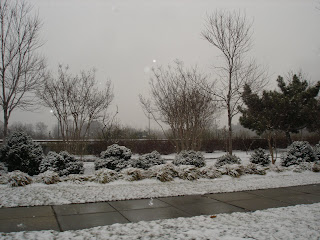
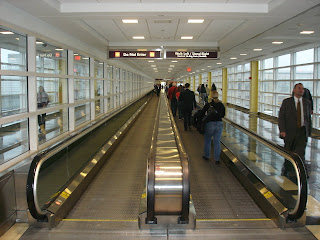
Below are a few photos from my recent visit.

CAIR's office
 New Jersey Avenue. The blurry thing in the center of the picture is the Capitol. Blame the weather for not being able to see it.
Trees crying for help: "Get me some sun light, take me to California"

Walking...

My ride back to the warmth of California
Monday, February 26, 2007
An Oasis called airport chapel
 Like a thirsty desert wanderer seeking an oasis, I seek airpot chapels. My work requires from me frequent traveling across the country with stops for connecting flights in Houston, Denver, or Chicago - three airports that I like because they each have a chapel.
I now choose specific flights and airlines to ensure that I land at certain terminals close to the chapel. Those chapels are my pit stop to refuel on my spiritual energy. They help provide me with the private space to perform my prescribed prayers (Muslims offer five obligatory daily prayers that fall throughout the day) and if time permits, read some Quran. After a long flight, crammed between tight airplane rows, surviving seat neighbors who confused you for their therapist, and digesting the generous peanut meals, one can use a chapel.
If you have not figured it out yet, I love chapels.
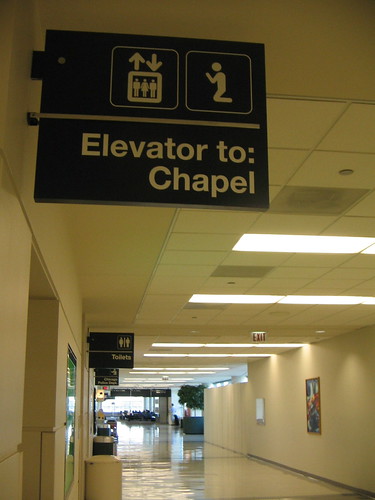 As soon as the airplane lands, I rush out to the restroom to freshen up with an ablution (pre-prayer Muslim wash up, called Wudu'). Then I head to the chapel. Just the scene of the chapel sign brings peace to my mind that my link with Allah/God is getting near. What a relief. For Muslims, the prayer is called Salat which literally means "link" because it is a time to link and connect with our Creator.
So next, I enter the chapel and sign my name in the guest book to make sure that the chapel managers and care takers know how much I appreciate what they offer us travelers through this chapel. "God Bless you" is what I comment next to my name on the book. Indeed, I am so grateful to them. I also do my share in sending a humble donation in response to those chapels' mail solicitation. Keep in mind, most chapels depend on the support of their visitors and the local nonprofit organizations.
The chapel consists of a small room with chairs and a podium. It is open and is regularly used by people of all religious backgrounds. In respect of individual beliefs, no religious symbols are present in the room. However, the religious books of each faith and prayer mats for Muslims are available. A sign shows the direction for the Qibla (direction to Makkah).
I extend the mat and offer the Salat (prayer), then sit to read from the Qur'an or just enjoy a few moments of quiet, peace and relaxation. I can not describe the feeling of rejuvenation. I am now ready for my next flight. It is not uncommon to see a Christian kneeling for a prayer or reading the Bible while a Muslim is close by prostrating during a prayer. What a pleasant scene of spirituality and mutual respect.
In case you are interested, I learned that the first airport chapel was established in 1950 at Boston’s Logan International Airport to provide a place where airport employees and travelers could fulfill their worship obligations.
According to a USA Today article, "about three dozen U.S. airports — including most of the big ones — have chapels or chaplains." Therefore, the next time you travel, chances are there is a chapel near you. Try it. You might fall in love with chapels too. One does not survive on airport smoothies and food alone.
Friday, February 02, 2007
Who dares to use the "A" word
Every topic and issue is open to discussion and debate in America. We can debate our occupation of Iraq. We can debate religion. We can debate God's existence. We can debate and dissent with our President's views and decisions. However, one dares not debate Israel and its policies. One dares not describe Israel's discriminatory practices using the "A" word.
The "A" word? You might ask.
Yes, the "A" word. I am talking about "Apartheid".
The Merriam-Webster Online Dictionary defines "Apartheid" as:
"racial segregation; specifically : a former policy of segregation and political and economic discrimination against non-European groups in the Republic of South Africa."
Many independent and objective experts and observers have pointed to the many similarities between the practices of the former Republic of South Africa against the indigenous Black Africans and those of the Israeli government against the indigenous Palestinians.
However, every one who has dared to speak out on this topic has had to deal with a vicious campaign of defamation and intimidation. Such campaigns aim to silence every attempt to debate the Middle East conflict and to make a lesson out of those who dare to suggest such a debate. Ironically, it is politically safer even for our politicians to be critical of our own government than of Israel!
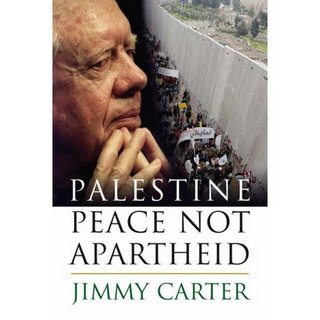 The political lynching of President Jimmy Carter for daring to use the word Apartheid in his new book is a good example of how even a former president is not allowed to debate Israel and its policies. Extremist supporters of Israel labeled President Carter as an anti-Semite.
(Show support for President Carter. Order the book and read it. Palestine: Peace Not Apartheid )
Our country's national security requires that we objectively debate whether our unconditional support for Israel and its policies are harming our credibility and standing in the world.
Our values and principles demand that we stand for justice and peace and speak out against racism, occupation, and all forms of injustice, regardless of who the victims or the aggressors are.
All people of the Middle East, Muslims, Christians, and Jews, are counting on our courage and moral values to end the occupation, promote dialogue, and support a just peace. We can't let them down out of fear of being criticized by extremists, on all sides.

Let's first begin by challenging the Apartheid practices. I encourage you to visit the website of US Campaign to End the Israeli Occupation and learn about their efforts and their new anti-Apartheid campaign.
 FORMER PRESIDENT
JIMMY CARTER
ON ISRAELI APARTHEID:
"In the West Bank, in the
occupied territories, a horrible
example of apartheid is being
perpetrated against the
Palestinians who live there.
Israel has penetrated and
occupied, confiscated and
colonized major portions of the
territory belonging to the
Palestinians."
CNN, November 28, 2006
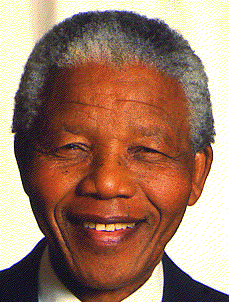 FORMER SOUTH AFRICAN
PRESIDENT NELSON MANDELA
ON ISRAELI APARTHEID:
"The UN took a strong stand
against apartheid; and over
the years, an international
consensus was built, which
helped to bring an end to
this iniquitous system. But
we know too well that our
freedom is incomplete
without the freedom of the
Palestinians."
Pretoria, December 4, 1997
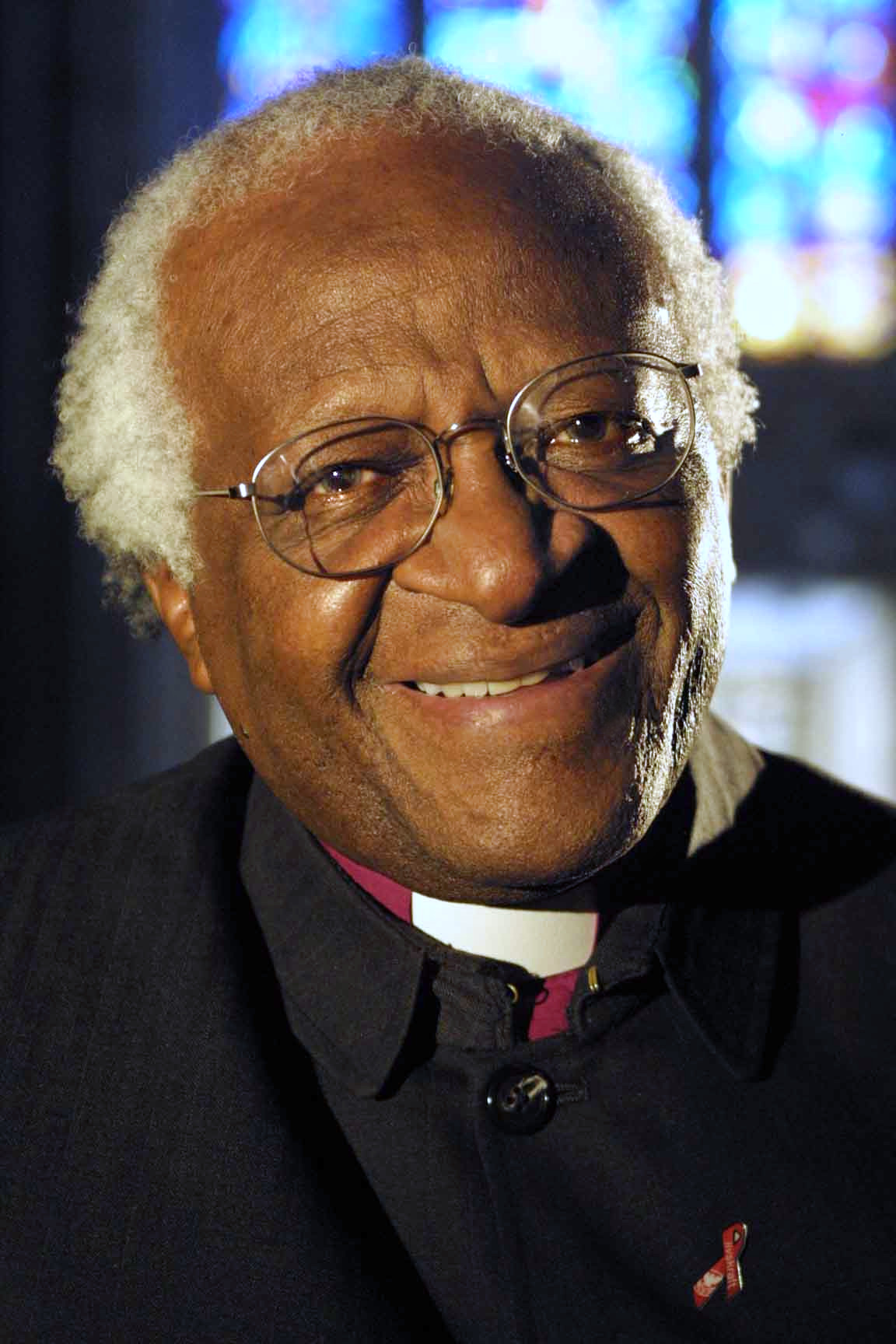 SOUTH AFRICAN
NOBEL PRIZE WINNER
ARCHBISHOP DESMOND TUTU
ON ISRAELI APARTHEID:
"I've been very deeply
distressed in my visit to
the Holy Land; it
reminded me so much of
what happened to us
black people in South
Africa."
The Guardian, April 29, 2002
All people deserve to be treated with fairness and respect. Let's do our part to ensure that happens.
More to read:
Parallels Between Apartheid in South Africa & Israeli Policies
A Closer Look at Israel’s Apartheid Policies
Israel's apartheid - By Flore de Préneuf
Israel, Apartheid and Jimmy Carter - By Saree Makdisi
The "A" word? You might ask.
Yes, the "A" word. I am talking about "Apartheid".
The Merriam-Webster Online Dictionary defines "Apartheid" as:
"racial segregation; specifically : a former policy of segregation and political and economic discrimination against non-European groups in the Republic of South Africa."
Many independent and objective experts and observers have pointed to the many similarities between the practices of the former Republic of South Africa against the indigenous Black Africans and those of the Israeli government against the indigenous Palestinians.
However, every one who has dared to speak out on this topic has had to deal with a vicious campaign of defamation and intimidation. Such campaigns aim to silence every attempt to debate the Middle East conflict and to make a lesson out of those who dare to suggest such a debate. Ironically, it is politically safer even for our politicians to be critical of our own government than of Israel!
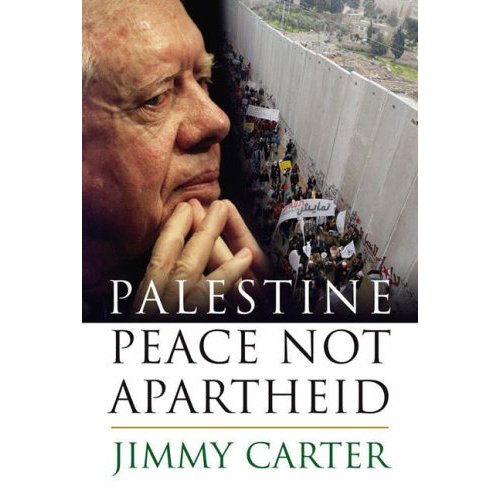 The political lynching of President Jimmy Carter for daring to use the word Apartheid in his new book is a good example of how even a former president is not allowed to debate Israel and its policies. Extremist supporters of Israel labeled President Carter as an anti-Semite.
(Show support for President Carter. Order the book and read it. Palestine: Peace Not Apartheid )
Our country's national security requires that we objectively debate whether our unconditional support for Israel and its policies are harming our credibility and standing in the world.
Our values and principles demand that we stand for justice and peace and speak out against racism, occupation, and all forms of injustice, regardless of who the victims or the aggressors are.
All people of the Middle East, Muslims, Christians, and Jews, are counting on our courage and moral values to end the occupation, promote dialogue, and support a just peace. We can't let them down out of fear of being criticized by extremists, on all sides.

Let's first begin by challenging the Apartheid practices. I encourage you to visit the website of US Campaign to End the Israeli Occupation and learn about their efforts and their new anti-Apartheid campaign.
FORMER PRESIDENTJIMMY CARTER
ON ISRAELI APARTHEID:
"In the West Bank, in the
occupied territories, a horrible
example of apartheid is being
perpetrated against the
Palestinians who live there.
Israel has penetrated and
occupied, confiscated and
colonized major portions of the
territory belonging to the
Palestinians."
CNN, November 28, 2006
 FORMER SOUTH AFRICAN
PRESIDENT NELSON MANDELA
ON ISRAELI APARTHEID:
"The UN took a strong stand
against apartheid; and over
the years, an international
consensus was built, which
helped to bring an end to
this iniquitous system. But
we know too well that our
freedom is incomplete
without the freedom of the
Palestinians."
Pretoria, December 4, 1997
SOUTH AFRICANNOBEL PRIZE WINNER
ARCHBISHOP DESMOND TUTU
ON ISRAELI APARTHEID:
"I've been very deeply
distressed in my visit to
the Holy Land; it
reminded me so much of
what happened to us
black people in South
Africa."
The Guardian, April 29, 2002
All people deserve to be treated with fairness and respect. Let's do our part to ensure that happens.
More to read:
Parallels Between Apartheid in South Africa & Israeli Policies
A Closer Look at Israel’s Apartheid Policies
Israel's apartheid - By Flore de Préneuf
Israel, Apartheid and Jimmy Carter - By Saree Makdisi
Subscribe to:
Posts (Atom)